
Two First-Year Students Present Scientific Research at National Conference
Anastasija Sutovic and Isabel Hernandez presented their research on electron clouds at the National Undergraduate Research conference in Richmond, Virginia.
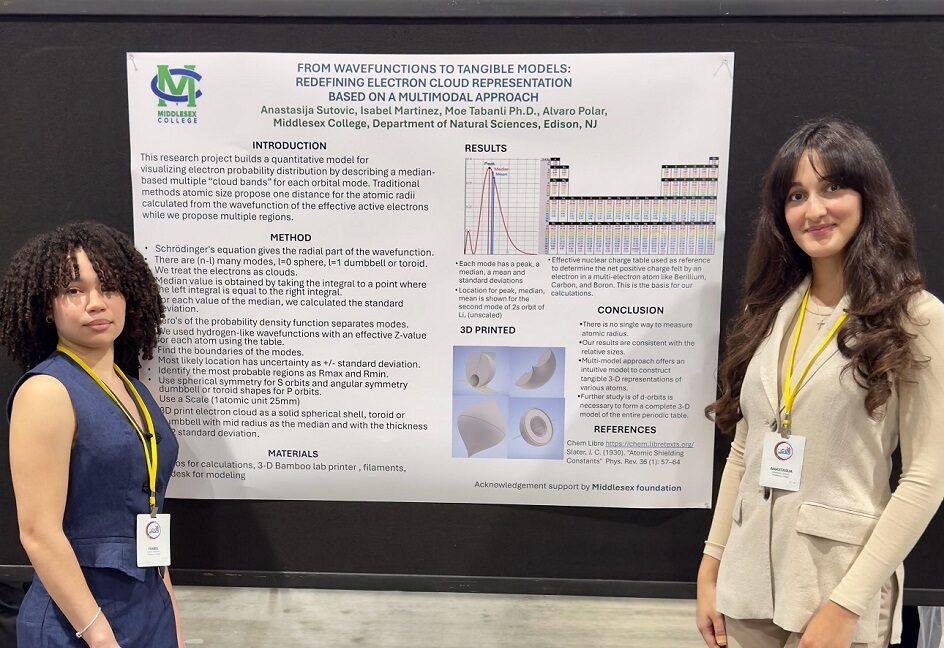 Isabel Hernandez (left) and Anastasija Sutovic
Middlesex College first-year students Anastasija Sutovic and Isabel Hernandez are out to solve the mystery of the cloud.
The pair presented an information poster and 3D-printed renderings projecting electron clouds around various atoms at the National Council on Undergraduate Research (NCUR) in Richmond, Virginia, in April.
“We treated atoms as clouds,” said Sutovic. “And our goal was to see the highest probability of the electron being in this spot, or another one.”
“In high school, we’re taught something very different—that the orbitals are circular and the electrons are a circle on a line, but that’s not actually accurate, it’s more like a cloud of probability,” said Hernandez. “You could take a guess of where they are, and you might be right, but there’s a chance you’re not.”
The conference, which draws students from across the nation, is like a giant science fair. Both students were impressed by the display of scientific applications and technologies and said they spent a lot of time explaining their design and research.
The idea of their project, which was partially sponsored by the Middlesex College Foundation, is to serve as an educational tool for students who want a visual representation in addition to lectures and written words.
“We hope that it will be part of the curriculum for many universities and colleges,” said Middlesex College Physics Professor Moe Tabanli. “Although it started as an educational tool, we arrived at unexpected results that may open doors for better understanding, more accurate calculations, an alternative representation for electron bounding that can be used in simulations to investigate properties of novel material.”
Hernandez, who has a goal of being a surgeon, and Sutovic, who wants to study biotechnology, plan on continuing their research.
“Quantum mechanics used to be an exclusive club for those who know it and others fascinated by it,” said Tabanli. “With the advances of technology and computational power, now the workforce needs people who know certain aspects of quantum science and its use in physics, chemistry, biology, electrical engineering, optics, and computer science. Our research closes the gap between the cutting-edge research and the general student population.”
