
2026-2027 Financial Aid Updates: The Working Families Tax Cut Act (formerly OB3)
The Working Families Tax Cut Act (formerly known as the One Big Beautiful Bill, or OB3, Act) was signed into law on July 4, 2025, through the budget reconciliation process. This legislation contains provisions that reshape student financial aid, including significant changes to the federal student loan programs, most of which become effective for periods of enrollment beginning on or after July 1, 2026.
Starting with the 2026-2027 Academic Year, new federal and state regulations under the Working Families Tax Cut Act (OB3) have changed how Federal Direct Loans are awarded and disbursed. These changes ensure that loan amounts align with a student’s actual enrollment and Cost of Attendance (COA).
2026-2027 Federal Direct Loan Awarding and Disbursement
How Your Loan Will Be Awarded
To ensure students have an early estimate of their funding, all Federal Direct Loan requests for the 2026-2027 year will be processed as follows:
- Initial Awarding: Loans will be tentatively awarded assuming Full-Time status, split equally between the Fall and Spring semesters.
- Note: Loan amounts are prorated based on Title IV-eligible credits at the time of awarding. Any change in enrollment status (adding or dropping Title IV-eligible courses) may automatically recalculate your total loan eligibility.
- Disbursement Adjustment: At the time of disbursement, your loan will be adjusted based on your Title IV registered credits.
- Note: Title IV registered credits are only those courses that apply directly toward your degree or certificate program. Courses that do not fulfill a program requirement cannot be used to determine your loan eligibility.
- Tip: To view your eligible credits, visit the Financial Aid home page in Self-Service and click on Financial Aid Enrolled Credits. Follow the step-by-step screenshots below for guidance.
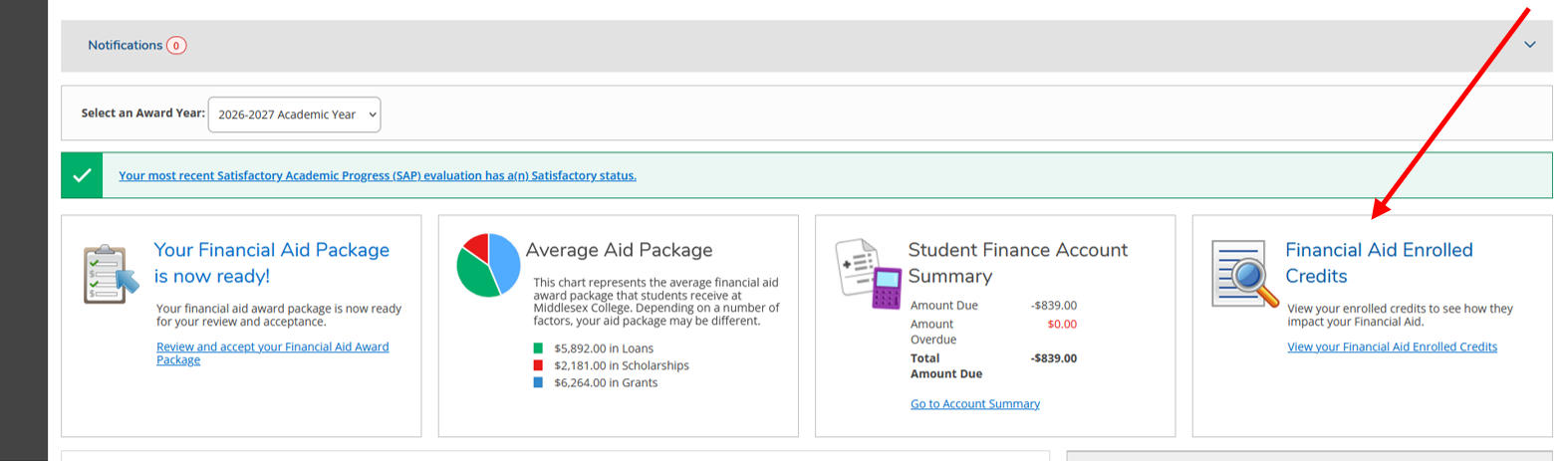
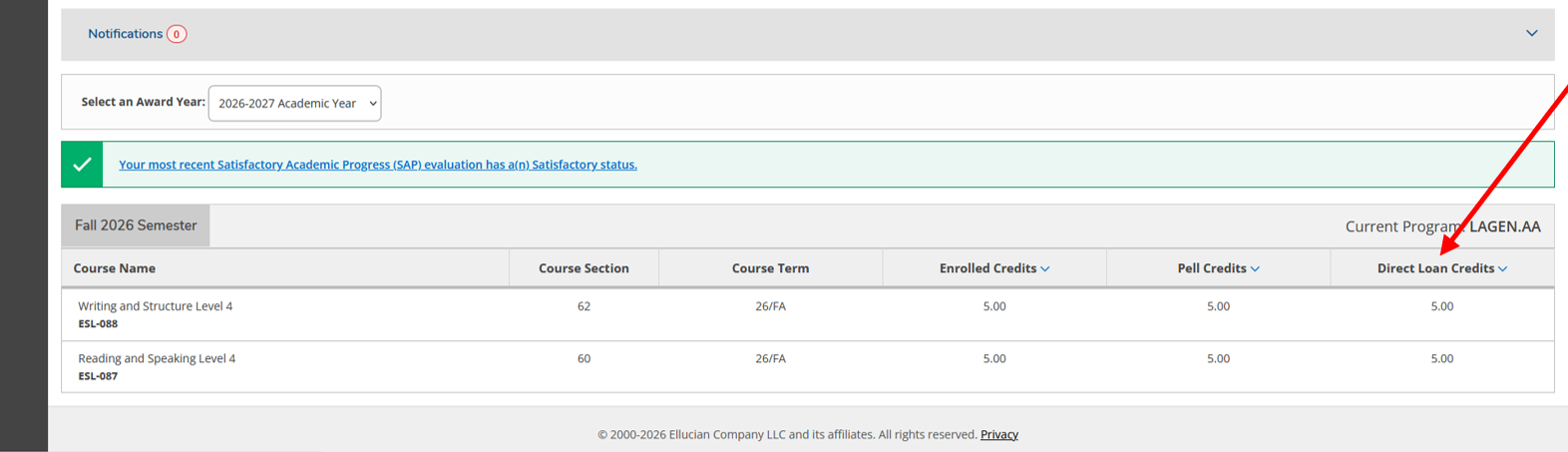
- COA Alignment: Under the Working Families Tax Cut Act (formerly OB3), if your enrollment level (based on Title IV credits) is less than full-time, your Cost of Attendance is reduced. Your loan must then be adjusted downward to ensure it does not exceed this new, lower cost.
Changes to Enrollment After Disbursement
Maintaining your enrollment status is key. Under the new guidelines, any changes made after your initial disbursement may impact your future funding:
- Dropped Classes: If you drop a class after your Fall loan has been disbursed, your eligibility will be recalculated for the entire academic year.
- Spring Term Adjustments: To account for a reduction in costs from a dropped Fall course, the Spring portion of your loan will be adjusted downward to reflect the change in your overall academic year budget.
What This Means for You
- Check Your Degree Audit: Before registering, ensure your classes are Title IV eligible by checking your degree requirements, accessible via Self-Service. Loans will only disburse based on credits that count toward your program.
- Consult Financial Aid Before Dropping: Because a change in your Fall schedule now directly impacts your Spring loan amount, we strongly recommend speaking with a Financial Aid Representative before withdrawing from any courses.
- Monitor Your Student Portal: All adjustments will be reflected in your student self-service portal. Please review your account frequently, especially during the first few weeks of each term.
- Monitor your Student Email: All financial aid updates and requests are sent to your Middlesex College Outlook account. Please check it frequently to stay informed about your aid status.
New Annual and Aggregate Limits for Federal Direct Parent PLUS Loans
Effective July 1, 2026, the Department of Education is implementing new borrowing limits for the Federal Direct Parent PLUS Loan program. These changes aim to promote sustainable borrowing for families.
What Are the New Limits?
For qualifying borrowers, the following maximums will now apply:
- Annual Limit: Parents may borrow up to $20,000 per academic year per student.
- Lifetime Aggregate Limit: Parents may borrow a maximum of $65,000 in total per student across all years of enrollment.
Who Is Affected?
These limits apply to parents borrowing a Federal Direct Parent PLUS Loan for the first time on or after July 1, 2026.
The “Grandfather” Provision (Exemptions)
The new limits will not apply for three academic years (through the 2028-2029 year) if:
- The parent received a Parent PLUS Loan for the student prior to July 1, 2026; OR
- The student received a Federal Direct Subsidized or Unsubsidized Loan prior to July 1, 2026.
Note: This exemption remains valid only as long as the student remains enrolled in the same academic program they were in prior to July 1, 2026.
What Remains the Same?
- Credit Requirements: Parent PLUS Loans still require a credit check. Parents with adverse credit history may still need an endorser or to document extenuating circumstances.
- Cost of Attendance (COA): Borrowing is still limited to the student’s Cost of Attendance minus any other financial aid received. If the $20,000 annual limit is higher than the student’s remaining “gap,” the parent can only borrow up to that gap.
- Application Process: Parents must still complete the Parent PLUS Application and Master Promissory Note (MPN) at studentaid.gov.
We Are Here to Help
We understand that changes to federal loan programs may impact your financial planning. We will share additional implementation details and guidance as they are finalized by the Department of Education.
In the meantime, you can find the latest news and official updates by visiting the Federal Student Aid website: studentaid.gov/announcements-events/big-updates.