
Disability Awareness Day Champions Inclusion and Accessibility
The awareness event aims to promote equity, respect, and opportunities for people with disabilities.
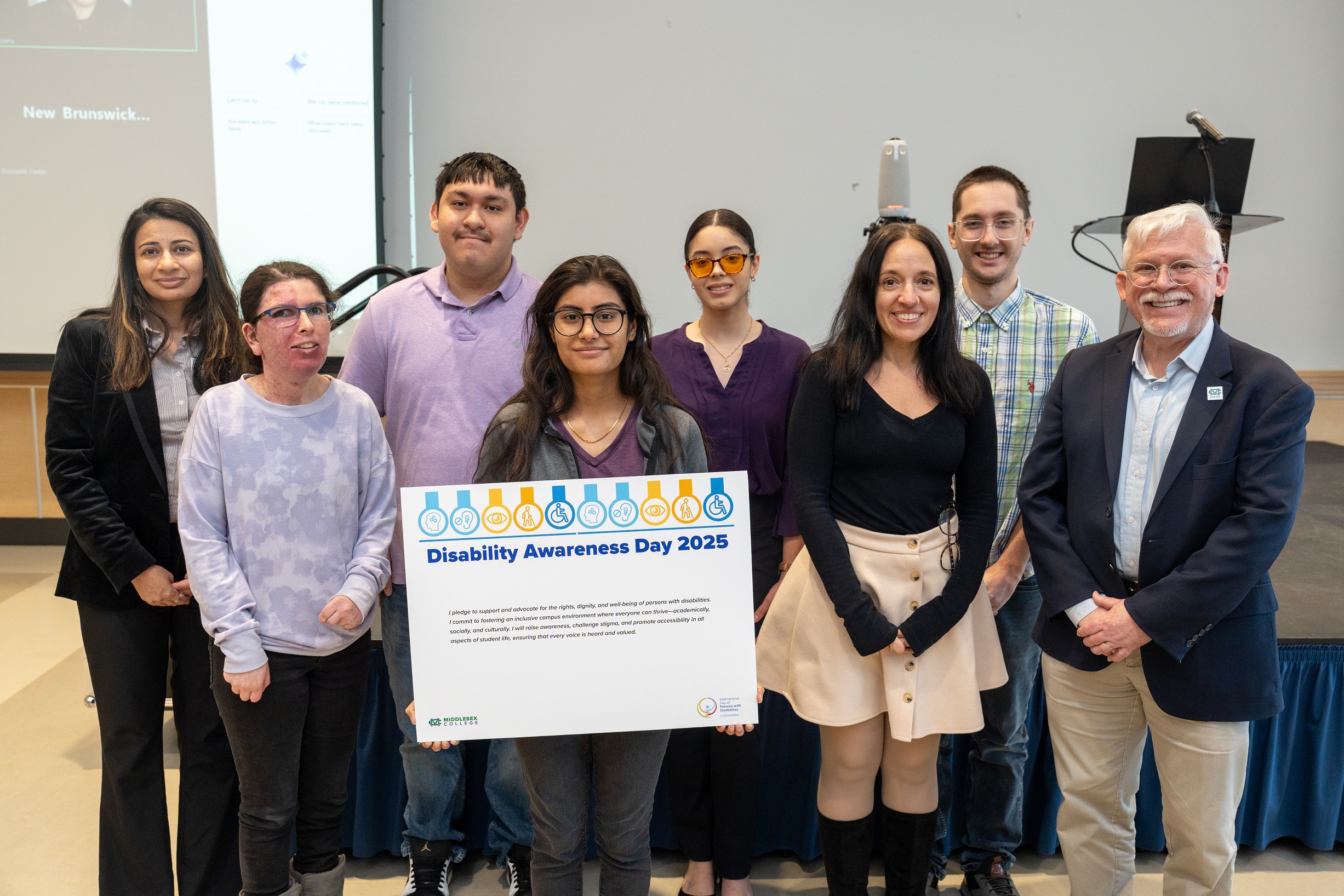 (l-r): Center for Accessibility and Disability Resources Director Dixita Malatesta; Student Engagement Specialist Jaclyn Perlman; Alexander Delgado; Laxita Kukreti; Raylisa Uceta Duran; History and Social Sciences Professor Nicole Gonzalez; Brandon Farano; Middlesex College President Mark McCormick
Middlesex College hosted Disability Awareness Day on December 3 to coincide with the United Nations designation of International Day of Persons with Disabilities. Disability Awareness Day recognizes the vital role disabilities play in shaping our vibrant, inclusive community.
“Equity is a vital facet of what we do at the College,” said Middlesex College President Mark McCormick in his opening remarks. “We try to find ways that every student, every person that comes here, has the specific tools that they need to succeed.”
The event came about after a student leader approached Center for Accessibility and Disability Resources Director Dixita Malatesta about more opportunities for allyship at Middlesex College.
“Disability Awareness Day is a collaboration of members of the Middlesex College community—student leaders, staff, faculty, and organizations who are dedicated to making the world a more equitable and accessible environment for those with disabilities,” said Malatesta to the audience.
“The community of the disabled is the largest minority group in the country and, quite uniquely, one that any of us can become a member of. And yet, it is often the most overlooked,” said Nikki Gonzalez, psychology professor.
Gonzalez, currently teaching a course titled Psychology of Persons with Disabilities, collaborated with Malatesta for the event to benefit her students and amplify the message to a larger audience. Gonzalez’s class also hosted a screening of Tuesco earlier in the day, a short film about a disabled Venezuelan man whose family support and dark humor help him continue to thrive.
The awareness event featured various student, staff, and faculty speakers who offered different viewpoints of being a disabled individual as well as an ally of the community. This offered a safe space for those of different perspectives to come together and discuss how the College can continue to cultivate a culture of awareness and inclusivity.
“One of the hardest things I experienced with having a disability was accepting that I had one,” said engineering science student Branden Farano. “Events like this help to not only spread awareness to those without disabilities, but also help those with disabilities embrace that part of their identity.”
Laxita Kukreti is a psychology student, president of the College’s American Sign Language club, and the older sister to her 13-year-old brother who was diagnosed with autism. In her speech, Krukreti reflected on the emotional complexity of advocating for her brother as she continues to navigate her own allyship and understanding of neurodiversity.
“It feels like I’m fighting for his acceptability, while making sure he has accessibility, or that he’s not too old to receive it, while I myself am still learning about what it means to be on the spectrum and/or neurodivergent,” said Kukreti.
